The hype is real. So is the limit.
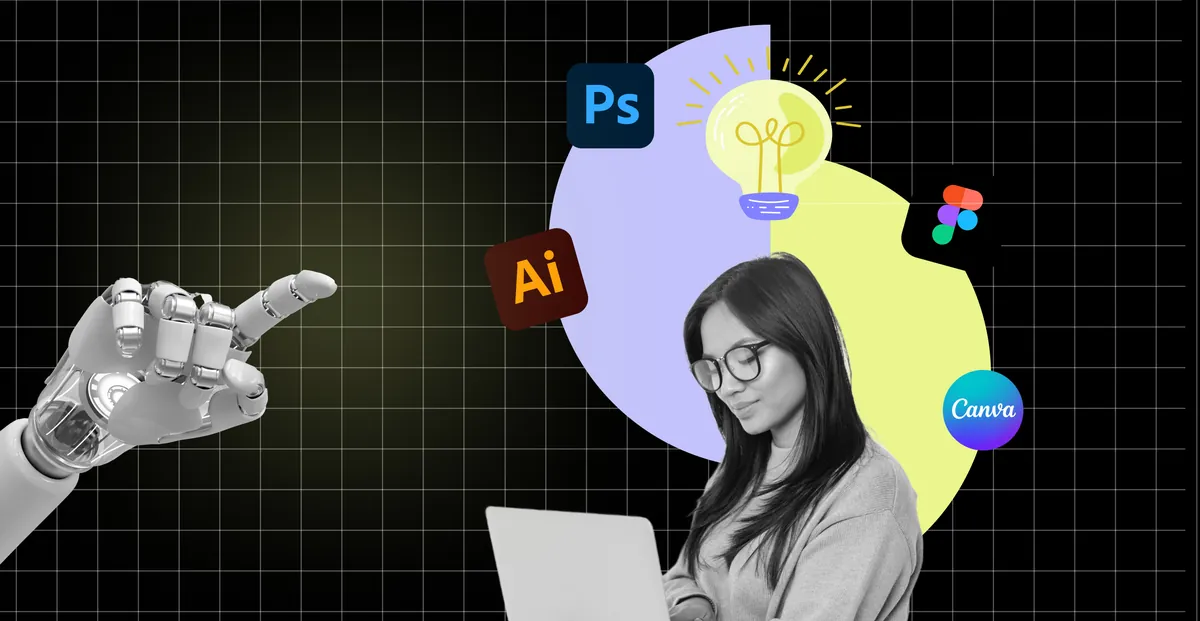
Every week there's a new AI tool promising to replace designers. Looka, Canva AI, Adobe Firefly, Midjourney — the list keeps growing. And if you're a small business owner watching your budget, the pitch is tempting: why pay a designer when AI can do it in seconds for free?
Here's the honest answer: it depends on what you actually need.
What AI is genuinely good at
AI tools have gotten remarkably good at certain things. They can generate logo concepts in seconds, create social media graphics from templates, produce stock-style imagery on demand, and help non-designers put together something that looks decent.
For a business that needs a quick banner, a placeholder graphic, or a first draft to react to — AI is useful. It's fast, it's cheap, and it doesn't require a brief.
What AI consistently gets wrong
Here's what nobody talks about in the AI hype cycle: AI doesn't understand your business.
It can't ask you why you started your company. It doesn't know that your customers are skeptical of anything that looks too corporate. It has no way of knowing that your competitor just rebranded in blue, so you should go a different direction.
AI generates. It doesn't think. And design — real design — is mostly thinking.
The other thing AI gets wrong consistently: consistency. A logo generated by AI today looks different from the one it generates tomorrow. Building a coherent brand identity across a website, print materials, social media, and packaging requires decisions that compound over time. AI resets every session.
And even in 2026, with tools like Midjourney v6, DALL-E 3, and AI-powered design assistants built into Canva and Figma, the core limitation hasn't changed. These tools are faster and more capable than ever at generating visuals — but they still can't sit in a meeting with you, ask why your last rebrand didn't feel right, or notice that your competitor just launched a website that looks exactly like what the AI is about to suggest. Speed without context isn't efficiency — it's just faster guessing.
The real cost comparison
Let's do the math honestly.
| Approach | Cost | Time You Spend | Brand Consistency | Strategy Included |
|---|---|---|---|---|
| AI tools (Canva, Looka, Midjourney) | $0–50/month | 5–10 hrs/week | Low — resets every session | None |
| Budget platform (Fiverr, 99designs) | $50–300 one-time | 2–5 hrs coordinating | Medium — template-based | Minimal |
| Freelance designer | $1,000–5,000 per project | 2–3 hrs briefing | High — built around your brand | Built-in |
| Agency | $5,000–20,000+ | 5–10 hrs in meetings | High — full system | Full strategy |
A DIY AI approach might cost you $0 to $50/month in tool subscriptions. But it also costs you time — hours learning tools, making decisions you're not equipped to make, and redoing work that doesn't land. For a business owner, that time has real value.
A one-time logo from a budget platform like Fiverr runs $50–300. You get what you pay for: something generic, probably built from a template, with no strategy behind it.
A freelance designer with real experience charges more — but delivers something built around your specific business, your audience, and your goals. That work compounds. A strong brand identity makes every future marketing dollar work harder.
The question isn't "is AI cheaper than a designer?" The question is "what does it cost me if my brand looks like everyone else's?"
Here's what designer-led branding looks like in practice →
When to use AI vs. when to hire a designer.
Here's a simple framework to help you decide:
Use AI when you need:
- A quick social media graphic for a one-time post
- A placeholder image for a pitch deck or internal doc
- Background textures, stock-style imagery, or filler content
- A first draft to react to before briefing a designer
Hire a designer when you need:
- A logo or brand identity that represents your business for years
- A website that needs to convert visitors into customers
- Consistency across your website, social media, packaging, and print
- Anything your audience will judge you by — because they will
The gray area is social media content. If you post once a week and don't rely on Instagram for revenue, AI templates might be enough. If your social presence is a core part of how clients find you, a designer who knows your brand will always outperform generic templates.
If you decide to hire a designer, here's how to write a brief that saves everyone time →
The honest bottom line
AI is a tool. Like every tool, it's powerful in the right hands and limited in the wrong context. For execution tasks — resizing an image, generating a background texture, creating variations — it's genuinely useful.
For strategy, identity, and the decisions that shape how your business is perceived? You still need a human who understands design, understands business, and takes the time to understand you.
The designers who will struggle are the ones doing template work. The designers who will thrive are the ones who do the thinking.
Working on a premium brand? The gap between AI and human design is even wider →
Frequently asked questions.
Is AI good enough for a startup logo?
For a placeholder while you validate your idea, sure. For a logo you'll put on business cards, your website, and your product packaging — no. AI logos can't be trademarked, they often resemble other outputs, and they carry zero brand strategy.
Will AI eventually replace designers completely?
Not the ones who think. AI will replace designers who only do execution — resizing, templating, production work. Designers who solve problems, build strategy, and make judgment calls based on understanding your business aren't going anywhere.
Can I use AI to create a design and then have a designer refine it?
Yes — and this is actually a great use of AI. Generating a few concepts to react to and then bringing a designer in to build the real thing is a smart workflow. Just don't expect the AI output to be the foundation — it's a starting point for conversation, not a draft to polish.
How do I know if my business needs a designer or if AI is enough?
Ask yourself: does my brand's visual identity directly affect whether people trust me enough to buy? If yes, invest in a designer. If your visuals are internal or temporary, AI tools can fill the gap.